



Author
James M. Corrigan
CFP®, CPWA®
Managing Partner
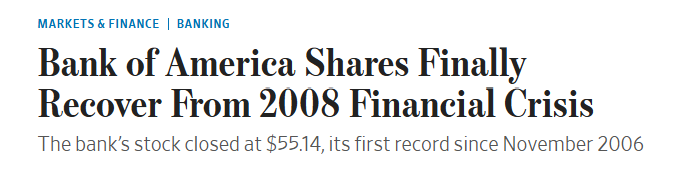
Reading the recent headline announcing that Bank of America had finally reached a new all-time high, surpassing its pre-Global Financial Crisis level, made me smirk.
It took nearly 20 years just to get back to even.
That headline pulled me straight back to April 21st, 2006, when I joined the investment group under Bank of America. I was young, ambitious, and, thanks to my move from Fifth Third Securities, the owner of newly minted stock options with a $55.00 strike price.
At the time, I didn’t fully understand how options worked, so I turned to the best resource I had: my dad (this was well before ChatGPT). He explained that if the stock traded above $55.00 within the next decade, I’d be “in the money.”
Then he gave me one crucial piece of advice: “Because your income and options are already heavily tied to BAC, I would refrain from purchasing the BAC stock fund in your 401(k) and instead use that space to diversify.”
When I joined Banc of America Investments (and no, “Banc” isn’t a spelling error, it was how the firm differentiated the bank from the investment group), the stock was trading around $46.00. Later that year, it began pushing toward $55.00 around November as the headline reads.
I remember the feeling clearly, the quiet confidence, the sense that wealth creation was around the corner. That belief that you’re early. It’s the same feeling many investors have probably felt at different moments over the last few years and do now.
Then the Global Financial Crisis hit.
By early 2009, Bank of America stock had collapsed to $2.53…a staggering 95.3% decline! My options were essentially worthless. They might as well have carried a $1,000 strike price.
Seeing that recent headline reminded me that it took nearly two decades for the stock to recover. When you run the math, the annualized return from 2006 to 2026 works out to roughly 1.2%.
That’s not investing. That’s anchoring.
If I delivered a 1.2% annual return to my clients over 20 years, they wouldn’t retire on time. They wouldn’t preserve flexibility. And they wouldn’t leave the legacy they intended.
That experience taught me one of the most important lessons of my career: Don’t fall in love with something that can’t love you back, like a stock.
As an RIA today, I think about risk very differently because I lived through that 95% drawdown. This experience shaped my investment philosophy:
- Beware of Concentrated Risk:
Don’t let a single stock dictate your future, and don’t tie both your income and your investments to the same company. I’ve seen this mistake made not only with Bank of America, but with Bear Stearns, Washington Mutual, Citi, and many others. The list goes on. - Control What You Can Control:
Diversify the core of your portfolio. Take calculated risks around the edges. - Discipline Over Loyalty:
Markets don’t reward loyalty. They reward discipline.
Thanks for the lesson, Pops. I have no doubt you’re looking down with a similar smirk.