


Resilience Amid Transition
The second quarter of 2026 was defined by several interconnected themes that continue to shape both the economy and financial markets. Geopolitical tensions in the Middle East reignited concerns over energy prices, while the U.S. labor market remained resilient despite showing signs of gradual cooling. Artificial intelligence continued to be the market’s dominant growth engine, with the story evolving from outsized earnings gains to a broader wave of capital raising and public offerings designed to fund the next phase of AI investment.
Meanwhile, the economy became increasingly divided. Higher-income consumers continued to spend, while lower-income households faced greater pressure from elevated borrowing costs and persistent inflation. Treasury yields moved higher as investors adjusted to a new Federal Reserve Chair and recalibrated expectations for interest rates.
Taken together, these crosscurrents have created what some strategists describe as the “Ho-Hum Economy”, an environment where economic growth remains positive but is becoming more selective, inflation continues to trend lower despite periodic spikes, and corporate earnings, particularly those tied to AI, remain the primary driver of equity markets. While the pace of expansion may be moderating, the underlying backdrop continues to support a constructive outlook for long-term investors, with leadership becoming increasingly concentrated in companies capable of delivering durable earnings growth.
Key Portfolio Adjustments in Q2
Trade Rationale | As of May 28, 2026
Staying Constructive While Becoming More Selective
The below is based on our discretionary managed portfolios.
- Reduced our equity overweight from 3% to 1%, modestly
lowering overall portfolio risk after a strong market advance. - Maintained our highest-conviction exposures, including U.S. large-cap equities, artificial intelligence, and innovation-driven themes.
- Enhanced international exposure through an actively managed country-selection approach, allowing for greater precision where opportunities are most attractive.
- Introduced a multi-strategy liquid alternatives allocation within fixed income, seeking additional diversification and return sources that are less dependent on stock and bond market direction.
Why We Made These Changes
Markets have rebounded sharply from the volatility experienced
earlier this year, with many equity indices approaching new highs.
While our positioning has benefited from this recovery, we believe
the risk-reward profile has become more balanced as valuations
have moved higher.
We got more selective on AI. The AI theme is alive and well, but the easy, broad-based gains are behind us. We moved from passive exposure to mega-cap tech toward active strategies focused on companies genuinely monetizing AI, the ones seeing real margin and productivity improvements. We expect bigger performance gaps to open up across semis, software, and adopters.
- Importantly, the fundamental backdrop remains supportive:
- Corporate earnings continue to exceed expectations
- The U.S. economy remains relatively resilient compared to manyglobal peers
- Ongoing investment in artificial intelligence and technology infrastructure continues to support productivity growth and long-term economic expansion
- While inflation has moved higher recently, much of the pressure has been concentrated in energy-related areas rather than broad-based economic overheating
- At the same time, uncertainty surrounding monetary policy, inflation trends, and geopolitical developments remains elevated.
Bottom Line: We remain constructive on the market outlook, but as
valuations rise and uncertainty persists, we believe a slightly more
balanced risk posture is appropriate. Our focus remains on participating in long-term growth opportunities while improving portfolio resilience across a wider range of market environments.
To learn more give us a call.
Q2 Recap
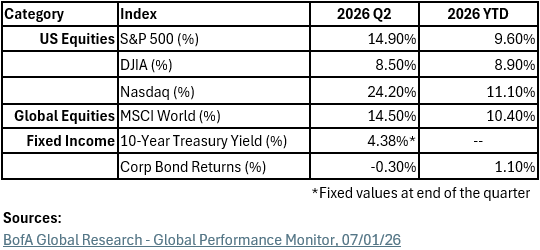
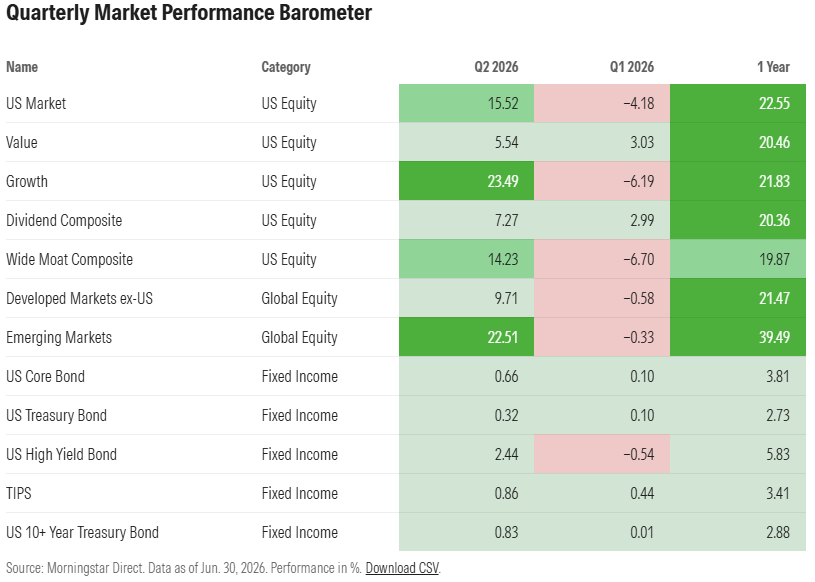
The equity markets rebounded sharply in the second quarter:
- Best quarter for stocks since the spring of 2020
- AI-Infrastructure spending fuled gains in memory and
semiconductor stocks while leadership broadened - The price of gold fell, experiencing its largest quarterly decline
since 2Q 2013
The Current Landscape
 Source: Federal Reserve Economic Data, Bureau of Economic Analysis, The Conference Board, The University of Michigan Consumer Sentiment, Bureau of Labor Statistics
Recession Probabilities
The recent memorandum of understanding between the United States and Iran has helped reduce geopolitical and economic uncertainty. Reflecting this improved outlook, Goldman Sachs lowered its 12-month U.S. recession probability from 25% to 15%, in line with its long-term average. The firm also raised its forecast for second-half U.S. GDP growth to 2%, citing the positive impact of lower gasoline prices on household purchasing power and the continued economic tailwinds from the AI investment cycle, including higher equity valuations and robust capital spending. 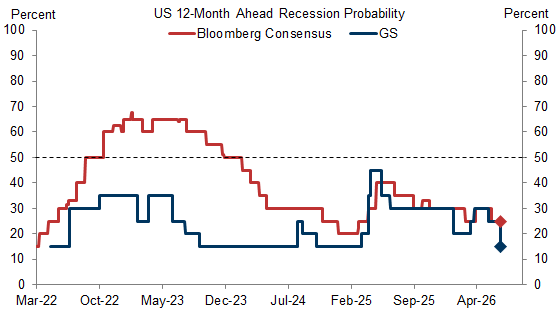
Source: Goldman Sachs Global Investment Research, Bloomberg
Earnings
A Look into Earnings and Q2 Expectations: By the Numbers
Q1 earnings season delivered the strongest results since Q4 2021.
Earnings momentum has carried into Q2. The S&P 500 is now expected to report year-over-year earnings growth of 23.1% for Q2 2026, up from the estimate of 18.8% at the start of the quarter on March 31. If realized, it would mark the second consecutive quarter
of earnings growth above 20% and the seventh straight quarter of double-digit earnings growth. Revenue growth expectations have also risen, with the index now projected to report 12.3% revenue growth, the highest revenue growth rate since Q2 2022 and the second consecutive quarter of double-digit top-line expansion. All
eleven sectors are projected to report year-over-year revenue growth.
Energy: Projected to lead all eleven sectors in Q2 2026 earnings growth at 123.2%, up dramatically from an estimate of 48.3% at the start of the quarter. The primary driver is a sharp year-over-year recovery in oil prices: the average price of oil in Q2 2026 to date is $93.71, roughly 47% above the $63.68 average in Q2 2025. At the sub-industry level, four of five sub-industries are expected to post growth, led by Oil & Gas Refining & Marketing (216%), Integrated Oil & Gas (161%), and Oil & Gas Exploration & Production (112%). Chevron and Exxon Mobil are the largest contributors to the dollar-level earnings increase since March 31.
Technology: Expected to report the second-highest earnings growth rate of all sectors at 63.2% for Q2 2026, up from 48.5% at the start of the quarter. All six industries within the sector are projected to grow, led by Semiconductors & Semiconductor Equipment at 131%. Revenue growth for the sector is expected to
come in at 34.2%, the highest of any sector, with Semiconductors leading at 75%. Micron Technology, NVIDIA, Apple, and Sandisk are the largest contributors to the dollar-level earnings increase since March 31. 44 of the 63 S&P 500 companies issuing positive EPS guidance for Q2 are from the Information Technology sector.
Materials: Expected to report the third-highest earnings growth rate of all eleven sectors at 35.3% for Q2 2026, up from 29.6% at the start of the quarter. All four industries within the sector are projected to grow: Metals & Mining (45%), Chemicals (43%), Containers & Packaging (18%), and Construction Materials (2%). Dow and LyondellBasell Industries are the largest contributors to the dollar-level increase in earnings since March 31.
Financials: Upward revisions to EPS estimates in the Financials sector have been among the contributors to the increase in Q2’s overall earnings growth rate. In Q1, Financials grew approximately 15%, driven by record equities trading revenues at Goldman Sachs and robust net interest income at JPMorgan. The forward 12-month
P/E ratio for the S&P 500 now stands at 20.1, above both the 5-year average of 19.9 and the 10-year average of 19.0, with the Financials sector continuing to offer relative value appeal at lower multiples (15.0x).
Communication Services: Expected to report the third-highest revenue growth rate of all eleven sectors in Q2 at 13.7%, with all five industries within the sector projected to grow, led by Interactive Media & Services at 22%. The sector remains among the market’s top revenue growers heading into the back half of 2026. Health Care: The only sector expected to report a year-over-year earnings decline in Q2 2026, at -9.0%, a sharp reversal from the +6.7% growth expected at the start of the quarter. The sector has recorded the largest percentage decrease in estimated dollar-level
earnings of all eleven sectors since March 31, down 14.7%. The decline is driven almost entirely by Gilead Sciences, which on May 7 issued annual non-GAAP EPS guidance of -$1.05 to -$0.65 due to $11.5 billion in IPR&D charges. If Gilead were excluded, the sector would be expected to report earnings growth of 7.1% rather than a decline.
For Q2 2026, expected S&P 500 earnings growth stands at 23.1% and revenue growth at 12.3%, which would mark the seventh consecutive quarter of double-digit earnings growth if realized. Ten of the eleven sectors are projected to post year-over-year earnings gains, led by Energy, Information Technology, and Materials, while Health Care isthe only sector expected to decline.
For Q3 and Q4 2026, analysts are projecting earnings growth of 26.7% and 24.2%, respectively. For full-year 2026, analysts are calling for 24.0% earnings growth and 11.2% revenue growth. The forward 12-month P/E ratio sits at 20.1, above historical averages but supported by an earnings cycle that continues to broaden and accelerate.
Source: FactSet Earnings Insight, June 26, 2026
The Consumer
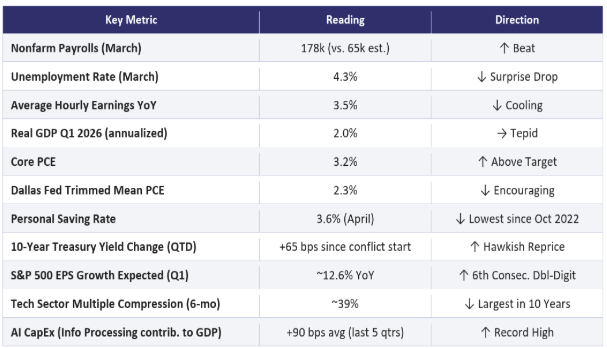
Consumers received some welcome relief during the quarter as gasoline prices declined following the easing of Middle East tensions. The University of Michigan Consumer Sentiment Index increased to 49.5 in June from 44.8 in May, marking the first improvement in three months. While confidence remains subdued and the cost of living continues to pressure household budgets, lower fuel prices and easing geopolitical uncertainty have begun to stabilize consumer expectations.
Source: University of Michigan Institute for Social Research, June 6, 2026
Interest Rates
The Federal Reserve held the federal funds rate steady throughout Q2 2026, keeping its target range at 3.50%–3.75% for the fourth consecutive meeting. Policymakers cited job gains that have kept pace with the workforce alongside inflation that remains elevated relative to the Fed’s 2% goal, with PCE inflation projections revised sharply higher to 3.6% for 2026, well above the March estimate of 2.7%. The June 17th decision also marked the debut of new Fed Chair Kevin Warsh, who removed forward guidance language from the FOMC statement and signaled that a rate hike remains on the table, with markets now pricing in a possible move as early as October.
Sources: Trading Economics – United States Fed Fund Interest Rate, 6/17/2026, CNBC – Federal Reserve, 6/17/2026
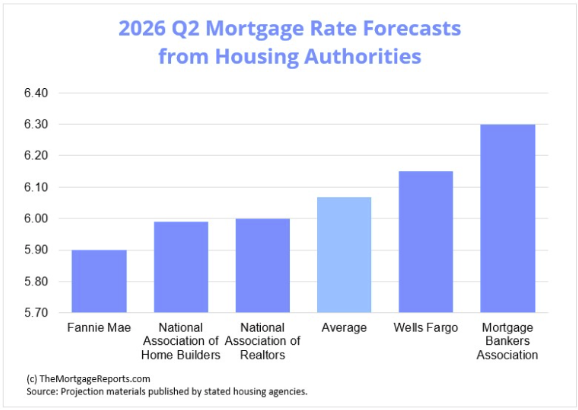
On the mortgage side, both the 30-year and 15-year fixed rates have trended lower on a year-over-year basis, the 30-year easing from 6.81% to 6.47%, and the 15-year from 5.96% to 5.81% as of June 18, 2026 (Freddie Mac, 6/18/2026). The 30-year rate has ranged between 5.98% and 6.52% so far in 2026, reflecting sensitivity to inflation data and Middle East tensions driving energy prices. While borrowing costs remain historically moderate, the shift in Fed tone suggests the rate environment could firm in the second half of the year.
Sources: Mortgage Reports, 5/28/2026, Freddie Mac – Mortgage Rates
On Burnham’s Radar
Trump Accounts
A new savings vehicle known as a Trump Account is scheduled to become available on July 4th 2026, providing families with another way to save and invest for a child’s future. Trump Accounts are custodial investment accounts for minors, with assets owned by the child and managed by a parent or guardian until age 18. Eligible children born between January 1, 2025, and December 31, 2028, may receive a one-time $1,000 government seed contribution, which does not count toward the annual contribution limit and is designed to jumpstart long-term savings.
From a financial planning perspective, Trump Accounts may be most attractive for families seeking long-term, tax-deferred growth outside of traditional education-focused vehicles. Contributions of up to $5,000 annually (indexed for inflation beginning in 2028) may be made regardless of whether the child has earned income. Investments are generally limited to low-cost, broadly diversified U.S. equity index funds and ETFs. Funds generally cannot be accessed before age 18, after which withdrawals are subject to rules similar to those governing traditional IRAs, depending on the use of the funds.
While the government seed contribution may make these accounts appealing for eligible families, they are unlikely to replace existing planning tools such as 529 plans, custodial Roth IRAs, or UGMA/UTMA accounts. For families primarily focused on funding future education expenses, 529 plans still offer more favorable tax treatment and greater flexibility for qualified education costs. In many cases, Trump Accounts may serve as a complementary savings vehicle rather than a primary one.
As with any new legislation, implementation details continue to evolve. We recommend evaluating Trump Accounts within the context of your broader education, retirement, and estate planning goals before deciding whether they belong in your family’s financial plan.
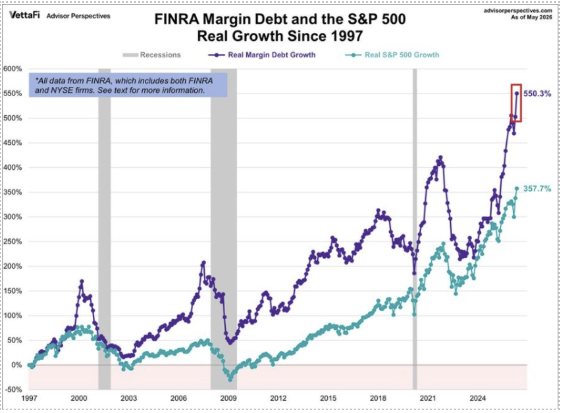
Margin Debt Increase: Market Leverage continues to rise at a historic rate
- US Margin debt jumped by +$112B in May, to a record $1.42T
- This marks the 2nd consecutive monthly increase, totaling
+$195B - Margin debt has surged +$495B, or 54% over the last 12 months
- Adjusted for inflation, this metric rose +7.9% MoM and +47.4% YoY
- Real Margin debt has now grown +550% since 1997, far
outpacing the S&P 500’s real gain of +357.7% over the same period
Credit Card Debt and Lending
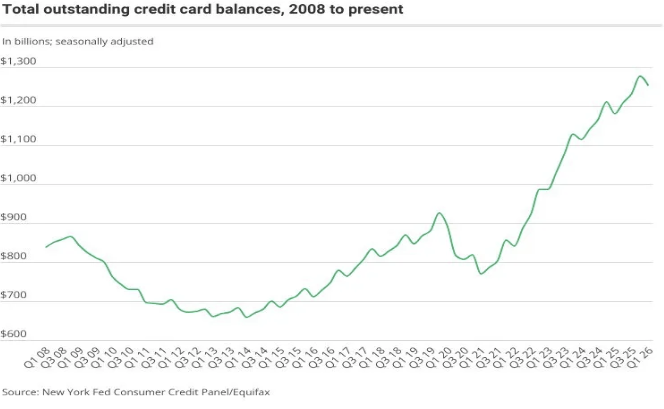
The most recent data available from the Federal Reserve Bank of New York, shows total household debt reaching a record $18.8 trillion in Q1 2026, with credit card balances pulling back slightly to $1.252 trillion after hitting an all-time high of $1.277 trillion in Q4 2025. Average APRs on cards accruing interest eased to 21.52% from 22.30% the prior quarter, reflecting the Fed’s late-2025 rate cuts, though rates remain historically burdensome for revolving borrowers. Notably, 53% of consumers report carrying balances to cover essential expenses; a signal that debt levels reflect financial pressure more than consumer confidence.
On the lending side, the April 2026 Senior Loan Officer Opinion Survey reported tighter standards for commercial and industrial loans across firms of all sizes, while early-stage credit card delinquency transitions edged down marginally from 8.7% to 8.6%, a modest improvement, though serious delinquencies remain elevated. Consumer spending has remained resilient in spite of these pressures, with retail and food services sales for March through May running 5.3% above the prior year period, though energy price inflation tied to the Middle East conflict is inflating a portion of those nominal gains
(Federal Reserve, 5/4/2026) (Federal Reserve Bank of New York, 5/12/2026) (U.S. Census Bureau, 6/17/2026).
401(k) Loans and Early Withdrawals
As market volatility and persistent cost pressures weighed on household finances during the second quarter of 2026, many consumers increasingly turned to their retirement accounts for short-term liquidity. Fidelity reported that 19.2% of participants had an outstanding 401(k) loan at the end of Q1 2026, up from 18.8% a year earlier, while hardship withdrawals also continued to rise. Although retirement savings remain an important financial safety net, the trend highlights the ongoing strain that inflation, housing costs, and economic uncertainty are placing on many households.
While 401(k) loans can provide access to funds without triggering taxes or penalties, they may reduce long-term investment growth and can become immediately due if employment ends. Hardship withdrawals can have an even greater impact, as withdrawn funds permanently leave the retirement account and lose future compounding potential. As consumers navigate an uncertain economic environment, maintaining adequate emergency savings remains one of the most effective ways to avoid disrupting long-term retirement goals.
(Vanguard – How America Uses Hardship Withdrawals, 3/11/2026) (Vanguard – How America Saves, 6/1/2026)
Geopolitical Risks & Opportunities
The agreement between the United States and Iran extends a pause and is not necessarily peace between the two countries. Nevertheless, the agreement is a welcome step towards deescalation, but we would remind clients that the situation remains volatile. Market relevance hinges on the details. We are focused on sanctions relief, asset unfreezing, enrichment limits, and uranium stockpiles. Further, we see risks to both the United States and Iran claiming “victory” in the short-term, which may raise the bar for restarting the conflict. Implementation risks, miscalculation, and potential reescalations will continue to be tail risks.
Despite the oil supply shock, improving business sentiment should continue to support US and global labor markets, allowing consumers to smooth through. Headwinds from fading One Big Beautiful Bill Act (OBBBA) fiscal stimulus should be offset by stronger business sentiment and declining uncertainty with the eventual reopening of the Strait.
Commodities
Commodities posted mixed returns during the second quarter, with energy prices rising due to heightened geopolitical tensions and concerns over global supply disruptions. Investors also remained focused on critical minerals and rare earth materials as governments accelerated efforts to strengthen domestic supply chains through initiatives such as Project Vault, highlighting the growing strategic importance of these resources beyond traditional commodity markets.
Government Spending and Deficits
Fiscal Snapshot – Q2 2026
The federal government’s fiscal position remains strained heading into the second half of FY2026. The cumulative deficit through the first eight months of the fiscal year reached $1.2 trillion, $116 billion less than the same period last year, with revenues up 5% and outlays rising 1% year-over-year. For the full fiscal year, CBO projects a $1.9 trillion deficit, equal to 5.8% of GDP, against total outlays of $7.4 trillion and revenues of $5.6 trillion (Congressional Budget Office – Monthly Budget Review, 6/8/2026).
The modest year-to-date improvement in the deficit reflects a revenue picture that is better than it appears on the surface. Customs duties surged 132% year-over-year through the first five months of FY2026, driven by tariff policy, while corporate income taxes fell 30% as the reconciliation bill allowed larger deductions for certain investments. The structural spending side remains the dominant long-term concern. Through the first eight months of FY2026, net interest payments on the national debt have run 8.8% above the prior year and have become the second-largest spending category in the federal budget, trailing only Social Security. CBO projects net interest costs will cross $1 trillion this fiscal year, a 7% increase from 2025, and more than double to $2.1 trillion by 2036. With mandatory programs continuing to expand and interest costs compounding, the long-term structural gap between spending and revenues shows little sign of narrowing. (Bureau of the Fiscal Service, 4/16/2026) (Bipartisan Policy Center, 5/1/2026)
The Long-Term Investing Playbook
As a reminder, most times it is best to ride out the ebbs and flows that the market experiences. Investors who bought on Jan. 1, 2025 and sold during the Liberation Day volatility would’ve experienced a realized loss of <15.09%> versus staying the course until Jan 1, 2026 and being up 17.88%, a 32.97% swing.
What we read/watched/listened to this quarter
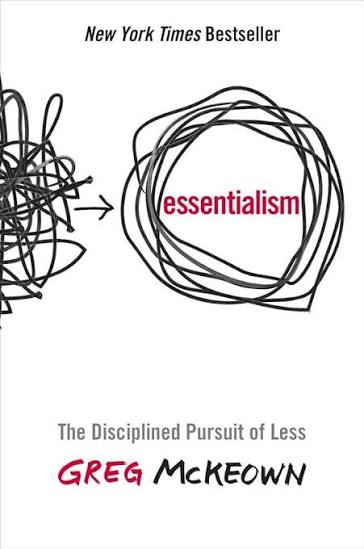
Essentialism: The Disciplined Pursuit of LessBy Greg MeKeown
Essentialism: The Disciplined Pursuit of Less is a masterclass on how to reclaim control of your time, energy, and focus. McKeown advocates for the idea that in a world full of choices and distractions, focusing on what truly matters and cutting out the non-essential is the key to leading a fulfilling and purposeful life. Through a combination of anecdotes, research, and practical advice, the author presents a comprehensive guide to embracing the essentialist mindset and achieving more with less.

James M. Corrigan, CFP®, CPWA®
Managing Partner
Jimmy BuffettFounders, A podcast by David Senra
Jimmy Buffett is often remembered for his music, but this episode explores the remarkable entrepreneur behind the Margaritaville empire and the discipline required to build one of the world’s most recognizable lifestyle brands. It also brought back memories of my Aunt Sheila taking me to my first Jimmy Buffett concert at Summerfest. It’s a reminder that Buffett was far more than a beloved musician…he was a visionary businessman who transformed a laid-back philosophy into an enduring global
enterprise.

Sean M. Jucas, CFP, CPWA, SE-AWMA
Managing Partner

2026 World Cup
The World Cup is arguably the greatest sporting event in the world. The World Cup showcases national identity, culture, history, and drama that no other sporting event can match. As an American, I feel a sense of pride that the World Cup is being held in United States. The World Cup is a chance for our country to welcome people all over the world, many for the first time, and to highlight all that is good about America. To quote Nelson Mandela, “Football has the power to change the world. It has the power to inspire. It has the power to unite people.”

David Holtkamp, CFA, CFP, CPFA
Managing Partner

AGAINST THE GODS: THE REMARKABLE STORY OF RISKby Peter L. Bernstein
Explores humanity’s journey from fatalistic beliefs to modern risk management, chronicling how the development of probability and statistics transformed our approach to uncertainty and decision-making.

Carla Voss Genelly, CIMA, CPWA, RMA
First Vice President, Wealth Advisor

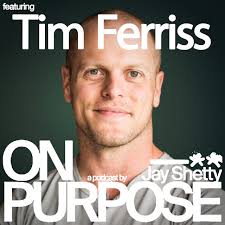
Tim Ferriss: Feeling Stuck Right Now?On Purpose, A podcast by Jay Shetty
Tim Ferriss and Jay Shetty explore the idea that meaningful growth comes not from doing more, but from aligning your actions with what truly matters. Tim shares lessons from years of personal experimentation, emphasizing that many people struggle not because they lack discipline, but because their priorities, focus, and behaviors are out of sync. The conversation also challenges the culture of
constant optimization, highlighting the importance of simplifying, letting go of
distractions, and avoiding burnout. Ultimately, they argue that lasting fulfillment comes from intentional living, focusing your energy on what matters most, and recognizing when slowing down is the right path forward.

Basel Alwawi
Registered Wealth and Investment Associate
Burnham’s Blueprint | July 2026
Registered Representatives of Sanctuary Securities Inc. and Investment Advisor Representatives of Sanctuary Advisors, LLC. Securities offered through Sanctuary Securities, Inc., Member FINRA, SIPC. Advisory services offered through Sanctuary Advisors, LLC, an SEC Registered Investment Advisor. Burnham Harbor Private Wealth is a DBA of Sanctuary Securities, Inc. and Sanctuary Advisors, LLC.
No representation is made as to the accuracy or completeness of information contained herein. The information is based upon data available to the public and is not an offer to sell or solicitation of offers to buy any securities mentioned herein. Any forward-looking statements are based on assumptions, may not materialize, and are subject to change without notice. Any investment discussed may not be suitable for all investors. Investors must make their own decisions based on their specific investment objectives and financial circumstances. Investments are subject to risk, including but not limited to market and interest rate fluctuations. Any performance data represents past performance which is no guarantee of future results.